Performance is not driven by talent alone. It is shaped by the quality of decisions people are able to make under pressure.
Yet most organisations invest heavily in identifying high performers while paying far less attention to the structures that govern judgement, risk-taking, and voice.
When those structures are weak or uneven, even the most capable people hesitate, go quiet, or burn out. The issue is not who gets to shine - but whether the ladder beneath them enables brave decisions rather than reckless ones.
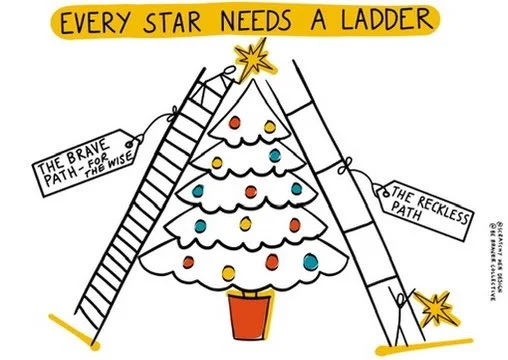
At this time of year, we place a star at the top of the tree. It signals arrival, aspiration, visibility.
In organisations, we talk about “stars” in much the same way: high performers, future leaders, people with potential. But no star reaches the top on its own. It gets there through structure, support, and balance. Not through a single bold leap, but through a series of deliberate steps - often taken quietly, under pressure, and out of sight.
The same is true at work.
Yet most organisations focus far more on identifying stars than on building the ladders that allow people to shine sustainably.
Everyone wants to shine, but not in the same way
Most people want to do well at work. That does not mean everyone wants the same outcome.
Not everyone is chasing promotion, status, or public recognition. For many, success looks like doing work they can be proud of, feeling respected, belonging to a team, providing stability for their family, or contributing meaningfully without burning out.
Most of us do not have a choice about whether we work. But we care deeply about whether our work feels worthwhile and whether we can do it well.
That is where performance really comes from.
Decades of organisational research show that people do their best work when they are supported to make good decisions under pressure - not when they are simply asked to deliver more, or increasingly, more for less. Sustainable performance depends less on individual brilliance and more on the conditions that shape judgement, risk-taking, and behaviour over time.
The unequal ladders behind success
Those conditions are not evenly distributed.
The ladders that allow people to progress - access to sponsorship, advocacy, stretch opportunities, and trust- vary significantly depending on who you are and where you sit in the organisation.
Data from Women in the Workplace illustrates this clearly. At entry level, around 31 percent of women report having a sponsor, compared with 45 percent of men. Women are less likely to be put forward for promotion, less likely to be offered high-visibility opportunities, and more likely to have their performance assessed on past delivery rather than future potential.
Over time, this compounds.
The same research shows that women and men are equally committed to their work. Yet women report higher levels of burnout and, for the first time in the study’s eleven-year history, lower interest in promotion. Crucially, that ambition gap disappears when women receive the same level of support and advocacy as men.
This is not a confidence problem.
It is not a capability problem.
It is a ladder problem.
Burnout is a signal leaders cannot ignore
This pattern does not exist in isolation.
Across the UK workforce, pressure is rising for everyone. Data from the Mental Health Foundation, the CIPD, and the Health and Safety Executive shows that a significant proportion of workers report struggling to cope with stress, experiencing moderate to high levels of work-related pressure, and showing increasing signs of burnout. Women and younger workers report the highest levels of strain.
Burnout is often framed as a personal resilience issue. In reality, it is a systemic signal.
Burnout occurs when people are repeatedly asked to carry emotional, psychological, and relational risk without adequate support or skill to manage it. It reflects decision fatigue and cognitive overload. When this happens, judgement deteriorates. People play safe. They go quiet. Or they push themselves beyond sustainable limits.
None of those outcomes support long-term performance.
What better support actually looks like
When organisations talk about better support, they often focus on visible interventions: wellbeing initiatives, leadership programmes, values statements.
These matter. But on their own, they rarely change how people behave when decisions carry real consequence.
The most consequential support is less visible because it sits beneath behaviour. It is the shared capability to recognise risk, exercise judgement, and act with courage under pressure.
Psychological safety creates the environment. It makes it possible to speak.
What is often missing is the capability to act once that space exists. Reducing fear and creating an inclusive culture does not replace the need for judgement when decisions carry risk. Without courage, psychological safety produces comfort, not progress.
“psychological safety produces comfort, not progress.”
Many organisations underestimate this gap. People may feel able to raise concerns in principle, yet still lack the awareness, language, or confidence to make courageous decisions in practice - particularly when hierarchy, reputation, or relationships are at stake.
Teams do their best work when:
uncertainty can be named without penalty
concerns are raised early rather than buried
disagreement is handled with trust and respect
boundaries are understood as responsibility, not resistance
These are not personality traits. They are learned behaviours, supported by shared language and practice.
Courage lives in everyday decisions
Many leaders say they want courage in their organisations. Far fewer invest in helping people understand how courage actually shows up at work.
Most workplace courage is not dramatic. It appears in small, frequent decisions:
Do I speak now or wait?
Do I challenge this in the room or afterwards?
Do I set a boundary, or absorb the cost myself?
Do I advocate for someone who is not present?
Without self-awareness and shared understanding, these moments are governed by fear, habit, or hierarchy. With training, reflection, and practice, they become intentional.
Decision-making research consistently shows that while professionals report high confidence in their judgement, very few have received formal training in how to make decisions under uncertainty. The result is a confidence–competence gap that increases risk, silence, and burnout.
Courage is not a personality trait.
It is a capability.
Advocacy, boundaries, and shared responsibility
Better ladders also change how advocacy works.
Advocacy is not only about sponsoring high performers. It is about noticing who is being overlooked, who is carrying disproportionate load, and whose voice is not being heard. It requires courage - particularly in environments where speaking up carries reputational or relational risk.
At the same time, people need the skill and permission to advocate for themselves. Setting boundaries, asking for support, or challenging assumptions are acts of courage, especially for those who are not in the majority.
When teams understand these dynamics, advocacy stops being exceptional. It becomes collective.
The leadership opportunity
If organisations want individuals and teams to shine, they need to stop focusing only on the stars and start paying attention to the ladders beneath them.
That means investing in:
environments that support responsible risk-taking
decision awareness under pressure
the courage to speak up and the capacity to listen
the skill to advocate for others, not just oneself
Better support does not remove challenge.
It makes courage possible.
And when people are equipped to take the right risks, at the right time, in the right environment, that is when individuals, teams, and organisations truly shine.