
A structured framework for leaders navigating complexity, uncertainty, and high-stakes choice
The problem with decision-making under pressure
Most leaders don't lack intelligence or experience. What they lack, in moments of genuine complexity, is a reliable way to slow down long enough to see clearly.
Under pressure, we default to instinct. We favour the familiar, defer to the loudest voice in the room, or rush toward resolution before we've properly understood the problem. We mistake speed for strength, and confidence for clarity.
The result is decisions that feel decisive in the moment — and costly in hindsight.
A different kind of decision-making tool
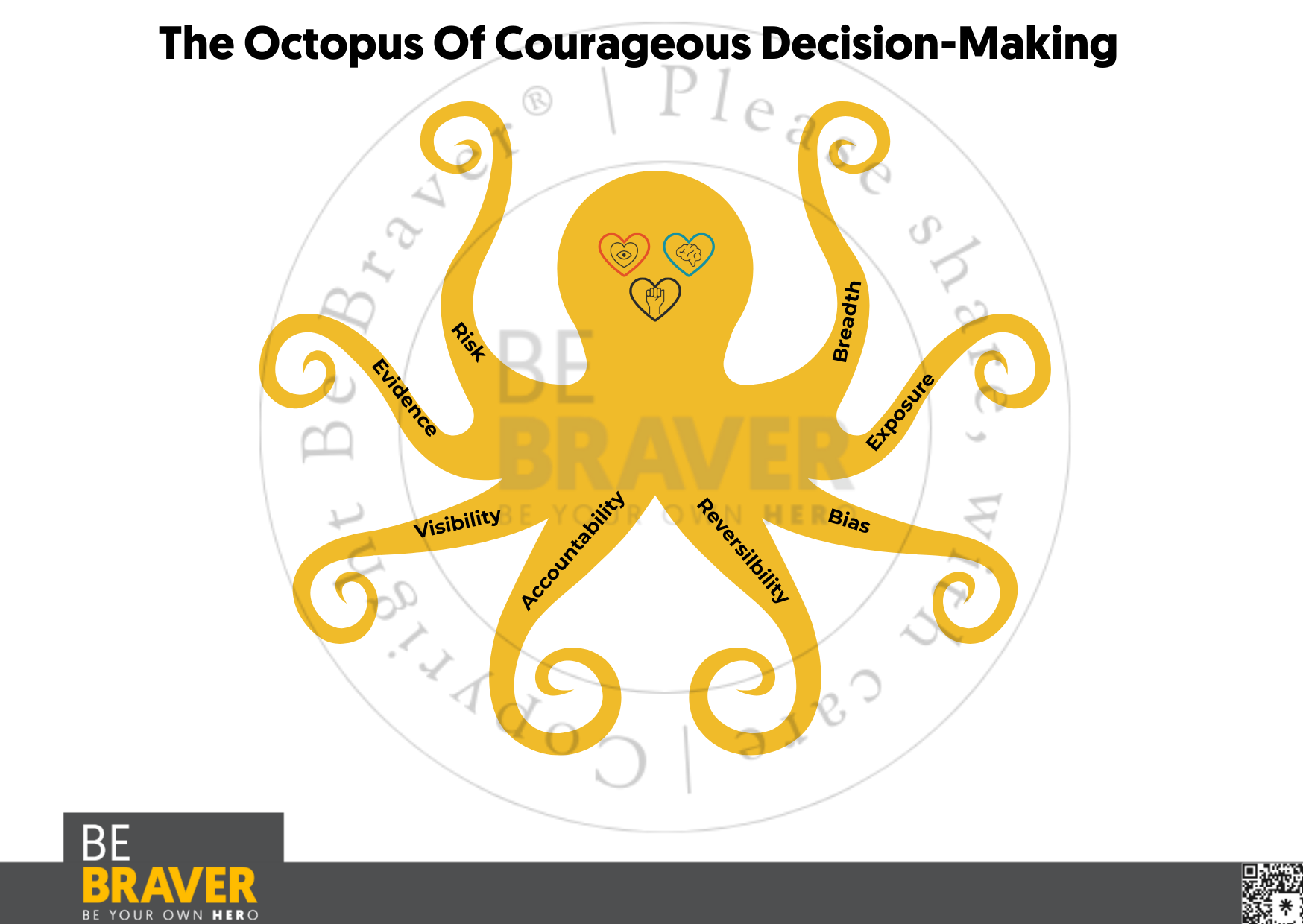
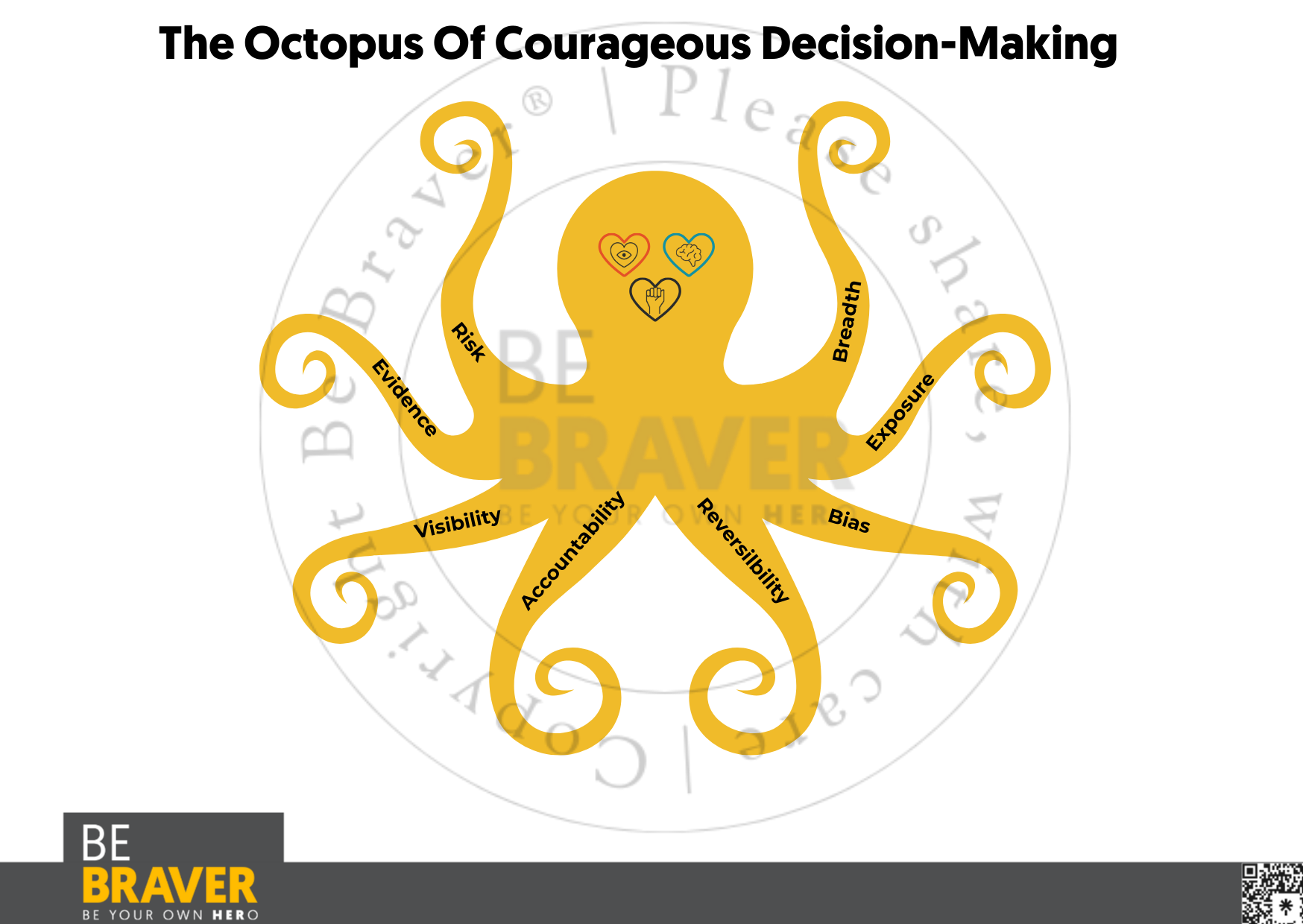
The Octopus of Courageous Decision-Making is a structured framework developed by Be Braver® to support leaders, teams, and organisations facing decisions where the stakes are high and the answers are not straightforward.
It draws on research into psychological safety, cognitive bias, and professional courage to offer something most decision-making tools don't: a way to engage not just analytically, but emotionally and behaviourally — because that is how humans actually make decisions.
The framework takes its structure from one of nature's most remarkable problem-solvers. An octopus operates through multiple independent centres of intelligence, each capable of sensing, responding, and adapting — while always returning to a central core. That architecture mirrors what effective decision-making requires: breadth of perspective, independence of thought, and a return to what matters most.
The eight intelligences of courageous decision-making
When the stakes are high, good decisions require more than one lens. The Octopus provides eight:
Breadth — Are you seeing the full picture, or only the part most familiar to you?
Exposure — What emotional, relational, or reputational risk is present for those involved?
Bias — What cognitive shortcuts or unconscious fears are shaping the options you're considering?
Reversibility — Is this decision a one-way door, or can it be revisited if circumstances change?
Accountability — Who is affected by this decision, and how are their interests being weighted?
Visibility — What will become known, and to whom, as a result of this choice?
Evidence — What is genuinely known? What is assumption? What is noise?
Risk — What are the visible stakes — and what remains hidden?
Working through these eight lenses moves decision-making from reactive to intentional, from pressured to principled, and from individually held to collectively owned.
Breadth, Exposure, Bias, Reversibility, Accountability, Visibility, Evidence, and Risk.
The Octopus didn't arrive fully formed. If you'd like to understand the thinking and research behind it, you can read the story of how it was developed [here].
Where the framework applies
The Octopus is particularly valuable in contexts where complexity is high and the cost of a poor decision is significant.
Common applications include governance and board-level decision-making, where clarity of process matters as much as outcome; internal audit and assurance functions, where professional courage is a core ethical requirement; risk and compliance environments, where bias and groupthink can quietly distort judgement; post-merger integration, where technical and cultural decisions intersect; and organisational restructuring, where the human consequences of decisions are often underweighted.
Octopus Decision-Making Workshops
Be Braver® delivers facilitated Octopus Decision-Making Workshops for leadership teams and organisations. Sessions are designed to be applied directly to real decisions your team is facing - not hypothetical scenarios.
Participants leave with a shared decision-making language, greater awareness of the cognitive and emotional factors shaping their choices, and a repeatable process for approaching complexity with confidence.
Workshops are available as standalone sessions or as part of a broader Be Braver® leadership programme.
To discuss a workshop for your team, or simply to find out more - please do get in touch.