Professional Courage

When self-awareness becomes a blind spot

The most conscientious leaders are often the quickest to ask: what am I doing wrong?

It is one of the things we admire most in the leaders we work with.

It is also the thing that sometimes gets in the way.

Self-awareness is a powerful leadership tool. But when it becomes the only tool, something important gets missed.

Every confidence wobble becomes an internal belief to work through. Every difficult relationship becomes a question of personal communication style. Every team that isn't performing becomes a question of the leader's own capability.

And the harder you work on yourself, the more invisible the other explanations become.

Sometimes the pressure isn't coming from inside you.

Sometimes it is operational : a structure creating confusion, a team under-resourced for what is being asked of it.

Sometimes it is commercial : a model that worked at one scale and doesn't work at another.

Sometimes it is strategic : a question the business hasn't answered, being felt by the people trying to lead within it.

Each of these requires a different response. None of them will be solved by working harder on yourself.

There is also a version of people development that inadvertently teaches people to tolerate things they should not tolerate. To adapt more gracefully to a situation that is not acceptable. To become more resilient in the face of something that should instead be challenged or changed.

Seeing that clearly, knowing what is yours and what isn't , is one of the marks of genuinely senior leadership.

It takes courage to look within. It takes a different kind of courage to look elsewhere.

We've explored this in full in Quiet Courage including what accurate diagnosis actually looks like in practice, and why getting it right changes everything.

The Transition from Expert to Leader

Unlearning can be harder than learning, unless you are brave-ready for change

There’s a career transition that catches even the most capable people off guard. Not often the move itself. The promotion, the new title, the expanded remit. But what comes after it.

You’ve built a career on knowing things. On being the expert in the room. On the depth of your technical knowledge, your ability to analyse, to solve, to deliver. That expertise is real. It got you here.

And then the role changes. The problems in front of you are no longer primarily technical. They’re relational, political, ambiguous. They require you to influence rather than direct, to hold complexity rather than resolve it, to develop people rather than outperform them.

The skills that made you excellent become, at best, insufficient. At worst, they get in the way.

Technical mastery gets you to the door. Human skills get you through it.

Unlearning is harder than learning

Most leaders, noticing a gap, focus on what to add. And the right frameworks, tools and language genuinely help - when the conditions are right for them to land.

But the harder work — the work that rarely gets named — is creating those conditions. And that means being willing to examine what needs to be shed.

The habits and instincts that became automatic on the way up don’t disappear when the context changes.

They just start producing the wrong results. The leader who resolves every problem because that’s what made them brilliant. The expert who struggles to delegate because no one else does it to their standard. The high performer who works twice as hard as everyone around them and wonders why they’re getting half the results.

This is particularly acute for leaders coming from engineering or software development backgrounds, where the distance between technical mastery and human skills is at its greatest.

When we work with those leaders, we often describe it this way: the code isn't broken. It’s just no longer the right version for where they are now.

This is especially true in the transition from technical expert to leader — a career transition that requires moving from a world where the right answer exists and can be found, to one where the most important skills are human: listening, influencing, creating the conditions for others to do their best work.

What actually changes things

What allows the rewrite to happen isn’t information alone. It’s space, outside perspective, and tools that are simple, practical, and grounded in the science of how people actually change.

Space to stop running on automatic. To look at the habits and assumptions that have become invisible precisely because they’ve been so useful. To ask not just what am I doing but why am I doing it this way, and is it still right for where I am now.

And perspective from someone outside your own experience — who can see the pattern you’re too close to name, and who can hold that observation in a way that opens things up rather than closes them down.

This is what changes things for the leaders we work with. Not simply a new toolkit. The capacity to examine what’s become automatic, to unlearn what no longer serves, and to relearn — with the benefit of someone alongside them who can see what they can’t.

The bravest thing

A brave-ready practice

Leadership is permanently uncertain. The environment shifts, the people around you change, and what's required of you keeps evolving. There is no point at which the adaptation stops.

That's not a problem to be solved. It's the nature of the role.

What allows leaders to stay responsive to that uncertainty is courage. The developed capability to recognise and navigate the relational, reputational, strategic and organisational risks that leadership continuously brings, and to judge, decide and influence well in the face of them.

That's what brave-ready means. Not that you've arrived. But that you've built the capability to keep adapting, to keep making good judgements, decisions and to influence well , throughout your career, not just at the first transition.

The best leaders aren't the ones who have it all figured out. They're the ones who stay genuinely open to seeing what they can't see on their own , and keep doing that work.

That’s what we call brave-ready.

That’s what Be Braver® is built for.


Work with Be Braver®

Whether you’re navigating this transition yourself, or you lead a team where you can see it happening - here’s how we help leaders become brave-ready.

Open Programmes

Our open programmes bring together leaders from across sectors to do this work in a cohort setting — with the benefit of peer perspective alongside expert facilitation.

The Be Braver Programme: Women in Leadership — now open for enrolment

Brave Governance Professional Programme — now open for enrolment

Be Braver for Data & Marketing Professionals — coming soon. Join the waitlist to be first to hear.

In-House

We work with organisations who want to bring this to their people directly - through bespoke programmes, workshops, and one to one or group coaching that builds brave-ready leaders from within.


Professional courage in governance: the capability the standards assume

The standards require it. What does it actually mean in practice?

“Demonstrate integrity and professional courage”

Standard 1.1 of the 2024 Global Internal Audit Standards requires internal auditors to perform their work with honesty and professional courage. The expectation is clear. The definition is not.

The Standards assume we already know what professional courage means. They do not explain how it shows up in the room, under pressure, when the issue is politically awkward and the consequences of challenge are personal rather than procedural.

This is where governance work becomes human.

Where professional courage is tested

Anyone working in second- or third-line roles recognises the moment. The tensions that arise when you are the one expected to raise the difficult point.

You are visible. You are accountable. You know that staying quiet would be safer.

Most governance leaders know what needs to be said. The harder question is how to say it well, at the right time, in a way that preserves influence rather than diminishing it, and then how to stand by that judgement when it is challenged.

That challenge is not primarily technical. It is behavioural.

The gap between knowledge and action

Governance functions invest heavily in frameworks, methodologies and technical rigour. Professionals are trained to interpret standards and follow process with care.

What receives less structured attention is the behavioural side of applying judgement under pressure.

Behavioural science research consistently shows that human decisions are shaped by cognitive bias, hierarchy, perceived threat and reputational concern. These forces influence how people speak, challenge and escalate - particularly when the stakes are high. Knowing the right answer and being able to act on it are not the same capability.

Professional courage sits in that gap.

Defining professional courage for governance

There are multiple definitions of courage across psychology, philosophy and organisational research. Some centre fear. Others emphasise moral virtue. Others focus on risk-taking behaviour.

Rather than assume a single universal definition, it is more useful to ask what courage must mean within the specific context of governance.

In oversight roles, the central issue is not dramatic heroism. It is the capacity to exercise independent judgement when doing so creates exposure.

For governance professionals, professional courage can therefore be defined as:

The enactment of independent, values-aligned judgement under conditions of experienced personal or relational exposure.

This definition is deliberate. It recognises that:

  • Courage in governance is rarely physical; it is reputational and relational.

  • Exposure is often social rather than procedural.

  • The potential cost may be to standing, influence or professional relationships.

  • The actor is aware of that exposure when choosing to act.

Courage, in this context, is not simply about emotion. It is about recognising exposure and exercising sound judgement anyway.

In governance environments, where visibility, accountability and hierarchy are real, that distinction matters.

Why professional courage is harder than it sounds

The leaders I speak with are rarely lacking integrity or commitment. They are navigating genuine complexity:

  • Incomplete or evolving evidence

  • Competing organisational priorities

  • Relationships that must endure beyond the difficult conversation

  • Sustained executive pushback

Professional courage is most demanding when the risk is relational and reputational rather than technical - when the exposure is social, political or career-impacting rather than procedural.

The hesitation before raising a concern. The pull toward a softer version of the truth. The gradual erosion of confidence under challenge.

These are not failures of knowledge. They are human responses to exposure.

What behavioural science adds

When stakes are high, the brain becomes more sensitive to threat. Cognitive biases can distort risk perception. Social hierarchies can amplify the perceived cost of dissent. The desire to protect credibility or preserve working relationships can quietly compete with the duty to challenge.

In oversight roles, these pressures are intensified. Scrutiny is high. Authority structures are visible. Relationships must continue after the meeting ends.

Professional courage is therefore not merely conviction. It is judgement exercised within a web of psychological and social pressures.

Understanding those pressures does not dilute governance. It strengthens it.

Developing professional courage

If professional courage were purely a personality trait, Standard 1.1 would offer limited practical leverage. But it can be strengthened.

In my work at the intersection of psychology, neuroscience and applied decision science, three areas consistently matter:

Cognitive awareness
Recognising how bias, hierarchy and threat responses influence judgement and communication.

Relational capability
Learning how to challenge constructively - maintaining connection while expressing difficult truths.

Behavioural practice
Rehearsing escalation, executive challenge and difficult conversations so that courageous action becomes deliberate rather than reactive.

Professional courage grows through structured reflection and practice - just as technical governance capability does.

Governance for good is behavioural

Principle 1 assumes integrity and professional courage are present. But these are not checklist items. They are behaviours.

They show up in how executive pushback is handled. In how hesitation is managed. In how independence is balanced with influence.

Governance failures rarely begin with incompetence. They begin with unraised concerns, softened language or delayed escalation.

Professional courage is the capability that interrupts that drift. The Standards assume it.

The question is how deliberately we choose to define it - and build it.

The Octopus of Courageous Decision-Making

A structured framework for leaders navigating complexity, uncertainty, and high-stakes choice


The problem with decision-making under pressure

Most leaders don't lack intelligence or experience. What they lack, in moments of genuine complexity, is a reliable way to slow down long enough to see clearly.

Under pressure, we default to instinct. We favour the familiar, defer to the loudest voice in the room, or rush toward resolution before we've properly understood the problem. We mistake speed for strength, and confidence for clarity.

The result is decisions that feel decisive in the moment — and costly in hindsight.

A different kind of decision-making tool

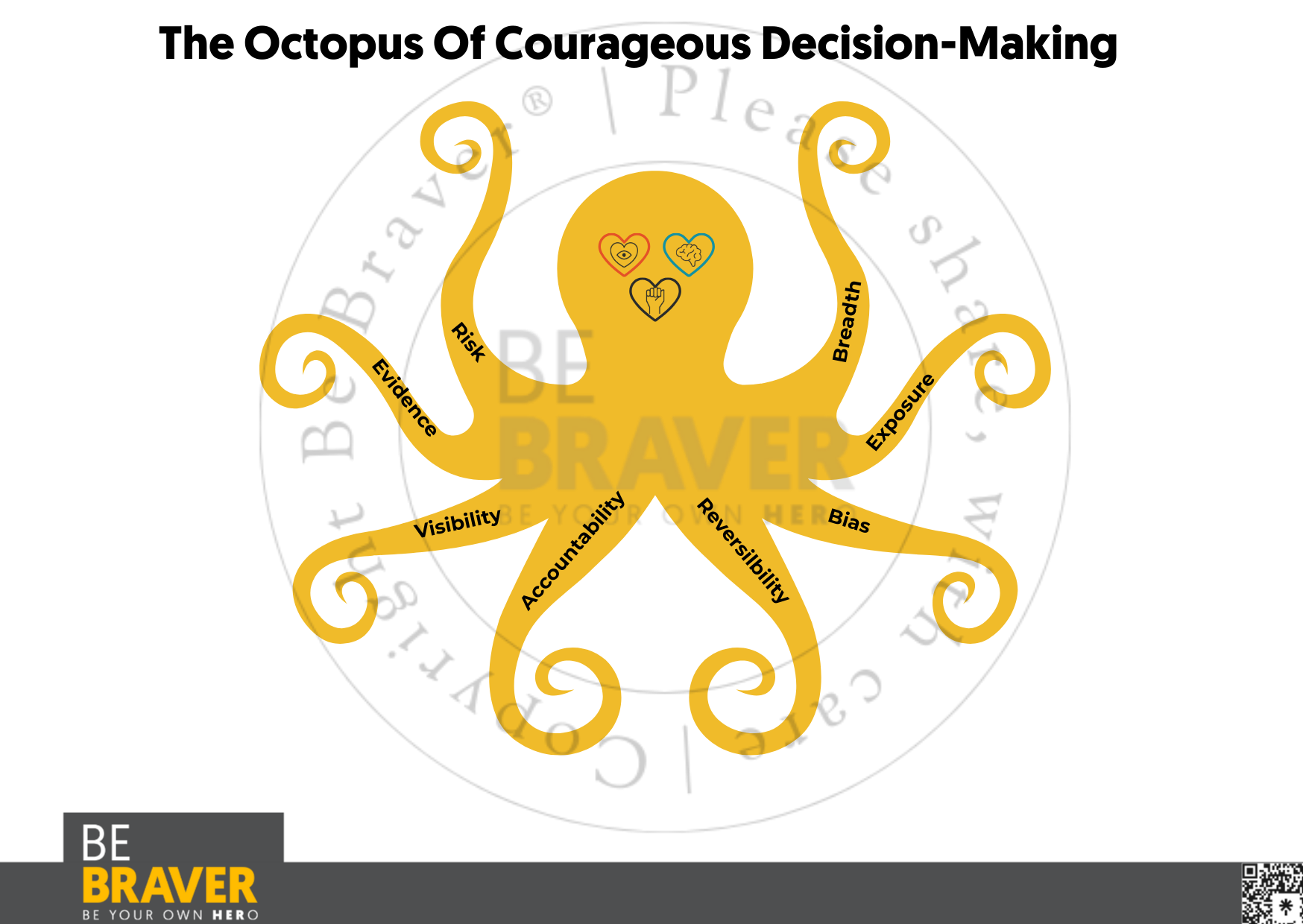
The Octopus of Courageous Decision-Making is a structured framework developed by Be Braver® to support leaders, teams, and organisations facing decisions where the stakes are high and the answers are not straightforward.

It draws on research into psychological safety, cognitive bias, and professional courage to offer something most decision-making tools don't: a way to engage not just analytically, but emotionally and behaviourally — because that is how humans actually make decisions.

The framework takes its structure from one of nature's most remarkable problem-solvers. An octopus operates through multiple independent centres of intelligence, each capable of sensing, responding, and adapting — while always returning to a central core. That architecture mirrors what effective decision-making requires: breadth of perspective, independence of thought, and a return to what matters most.

The eight intelligences of courageous decision-making

When the stakes are high, good decisions require more than one lens. The Octopus provides eight:

Breadth — Are you seeing the full picture, or only the part most familiar to you?

Exposure — What emotional, relational, or reputational risk is present for those involved?

Bias — What cognitive shortcuts or unconscious fears are shaping the options you're considering?

Reversibility — Is this decision a one-way door, or can it be revisited if circumstances change?

Accountability — Who is affected by this decision, and how are their interests being weighted?

Visibility — What will become known, and to whom, as a result of this choice?

Evidence — What is genuinely known? What is assumption? What is noise?

Risk — What are the visible stakes — and what remains hidden?

Working through these eight lenses moves decision-making from reactive to intentional, from pressured to principled, and from individually held to collectively owned.

Breadth, Exposure, Bias, Reversibility, Accountability, Visibility, Evidence, and Risk.

The Octopus didn't arrive fully formed. If you'd like to understand the thinking and research behind it, you can read the story of how it was developed [here].

Where the framework applies

The Octopus is particularly valuable in contexts where complexity is high and the cost of a poor decision is significant.

Common applications include governance and board-level decision-making, where clarity of process matters as much as outcome; internal audit and assurance functions, where professional courage is a core ethical requirement; risk and compliance environments, where bias and groupthink can quietly distort judgement; post-merger integration, where technical and cultural decisions intersect; and organisational restructuring, where the human consequences of decisions are often underweighted.

Octopus Decision-Making Workshops

Be Braver® delivers facilitated Octopus Decision-Making Workshops for leadership teams and organisations. Sessions are designed to be applied directly to real decisions your team is facing - not hypothetical scenarios.

Participants leave with a shared decision-making language, greater awareness of the cognitive and emotional factors shaping their choices, and a repeatable process for approaching complexity with confidence.

Workshops are available as standalone sessions or as part of a broader Be Braver® leadership programme.

To discuss a workshop for your team, or simply to find out more - please do get in touch.